Monday, May 18, 2015

Coming Soon: Another Encaustic Conference Hotel Fair

The International Encaustic Conference, founded and directed by Joanne Mattera, is held annually at the beginning of June in Provincetown, Mass. with pre- and post-conference workshops at Truro Center for the Arts at Castle Hill in Truro, Mass.  This year will be the ninth annual conference, and there are a few diehards, myself included, who have attended the conference every year since its inception.

After moving to the Provincetown Inn in 2011 in its fifth year, the conference has featured a hotel fair on Sunday morning, open only to conferees. What better way to look forward than to loIok back at some scenes from the 2014 hotel fair in the aptly-named (by us) "Three Queens Suite" of Susan Lasch Krevitt, Binnie Birstein, and myself.


Our Art News cover on the door to the Three Queens Suite


For the first time, three artists were featured on the cover of Art News and, imagine that(!}, it was us. This year, I heard that Art in America was sending a photographer.

Here are some images from our suite. First up, Susan Lasch Krevitt who installed her work on the kitchen cabinets. (We are generally not able to hang work on the walls because we don't want to damage them.)


Susan's Installation on kitchen cabinets

Since neither Susan nor I took more installation images, here are some closeups of the work.

Susan Lasch Krevitt, FT6 (open), 2014, 18 x 6 inches
Canvas, rubber, silk, twine, encaustic

Susan Lasch Krevitt, FT4, 2014, 9 x 6 inches
Canvas, rubber, silk, twine, batting, encaustic


Susan Lasch Krevitt, FT1 (closed), 2014, 18 x 4 inches
Canvas, rubber, silk, twine, encaustic

Susan and I shared the living room/kitchen for our work. Here are some images of my pieces.


Nancy Natale - mall pieces on the wall.
Through the doorway is the bedroom with Binnie's work.


Some other pieces of mine laid out on the coffee table.

A closeup of four works from the hotel fair

And finally, Binnie Birstein displayed her work in the bedroom. (Note that the sheets and pillowcases were covering the hotel's artwork which was left in place.)


An open portfolio on the bed showed encaustic monotypes and collagraphs


Binnie's matted collagraph and small paintings


Binnie herself speaking to a visitor about her work

Again this year we will all be showing our dynamic artwork and welcoming fellow conferees to our 3Q Suite. Hope to see you there!


We found this crown in a Provincetown shop. Too much?

P.S. If you want to look at some hotel fair shots from 2013, here's the link to my Art in the Studio blog.

Wednesday, March 11, 2015

Painting in Fayum Style With Encaustic and Cold Tools

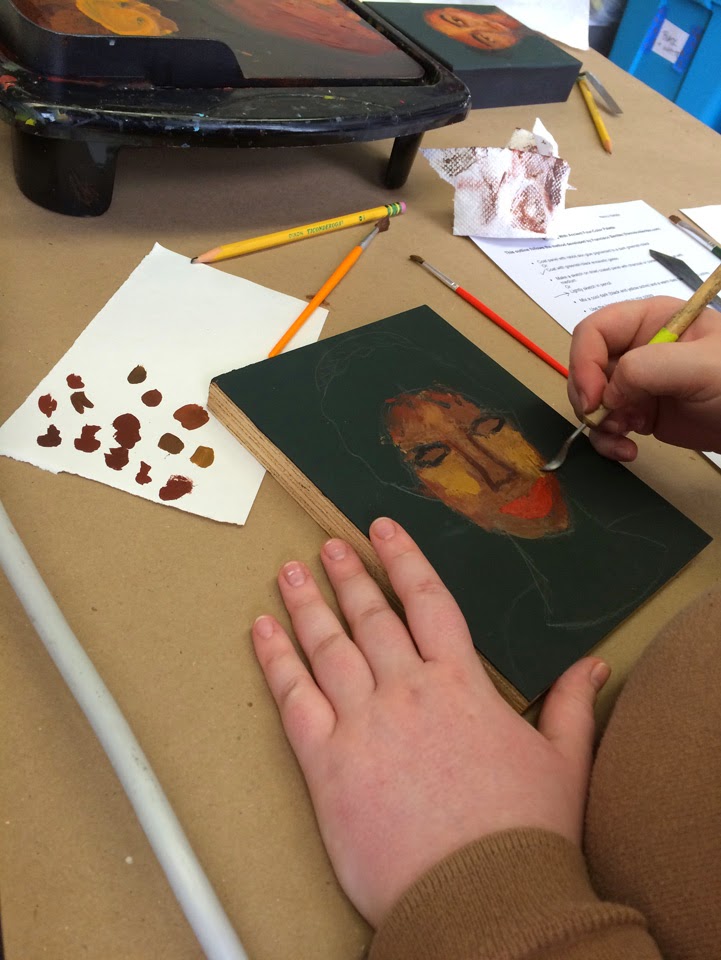
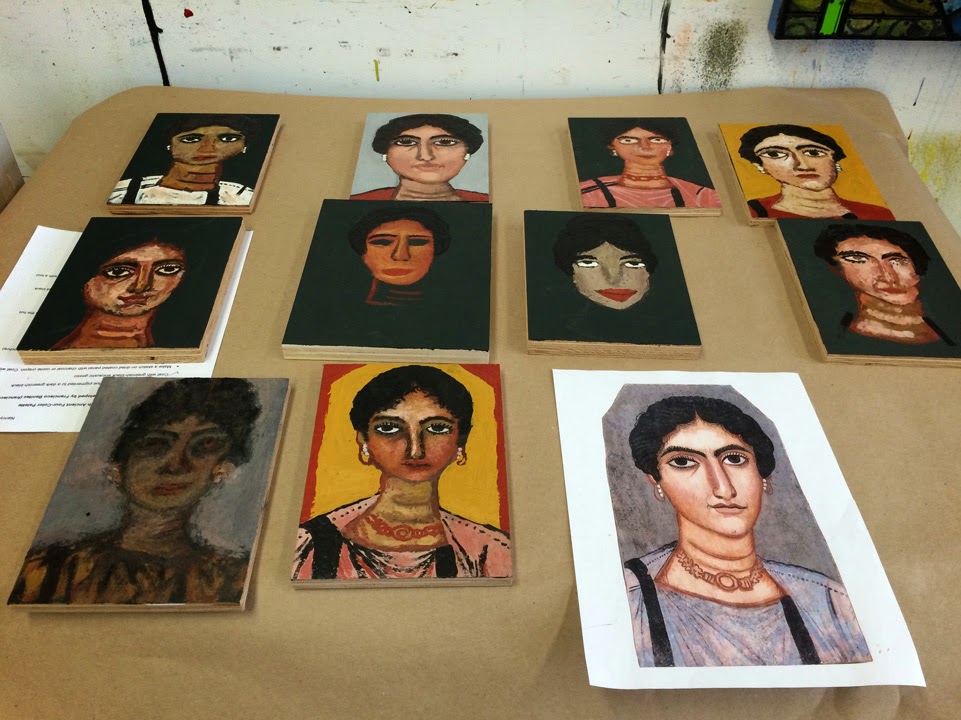
This is the fifth year I have hosted students from Smith College Museum's "Historic Methods & Materials" class in my studio. I teach them a little about encaustic with a Power Point about encaustic's history and then they experiment with encaustic painting. This year we spent one afternoon painting in the Fayum style using a four- color palette of encaustic paint based on four mineral colors: red ochre, yellow ochre, white (powdered gypsum or calcium carbonate) and black (ash).  (For more detail, see my 2010 blog post about the Homage to Fayum workshop taught by Francisco Benitez.)


Students worked from color copies of a Fayum portrait owned by Smith College Museum. They painted their portraits on small plywood panels that I had prepared with a greenish-black encaustic gesso. Using small brushes and fusing with small tools and palette knives that they heated by holding them on electric palettes, they each made their interpretation of the portrait. You could have heard a pin drop in the studio as they intently worked.


xxx

Tuesday, December 23, 2014

Christmas (Windows) in New York City

Ever since watching "Scatter My Ashes at Bergdorf's," I've wanted to see the celebrated B-G Christmas windows firsthand. Shopping at Bergdorf Goodman is totally out of my realm, but looking is something I can afford. This year I had to bring some art south for an upcoming show in New York (info at the bottom of this post), so a rendezvous with my dear friend Binnie was in order - just in time to see all the bright lights and magic of Manhattan at this special season of Selling.


Inspired by the Arts
The window theme this year is "Inspired" and each window is dedicated to a particular art that inspires. More than 100 artists and display artisans contributed to the windows.

Here is the Bergdorf Goodman statement about the windows:

We decided to base each window on a major art form, drawing equally from the fine arts, performing arts and applied arts. For our main windows, we settled on literature, architecture, theater, painting, music, dance, sculpture and film. Each window would be designed independently from the others. Each would be made from its own set of materials. But the entire set of windows would constitute a sort of eight-lesson course in art appreciation.

Windows Curated by Moi
Although all the windows were fabulous, I thought the first two were outstanding, so those are the two I am featuring.

This is the official photograph of the Literature window, photographed by Ricky Zehavi,
from the Bergdorf Goodman blog. Please click to enlarge.

This wonderful red window, dedicated to Literature, was made entirely from "fabric, soft sculpture, and needlepoint." I was blown away by all the detail. Here are a few of my iPhone pix. Please click on them to can see them enlarged because they are so rich.


My second most favorite was Architecture, done up mainly in blues. This window was composed from paper and old blueprints.

The official photograph by Ricky Zehavi from the B-G blog.

Here are some of my detail shots.


Looking Through Another Window
Seeing these wonderful compositions was really a treat. Then as we wandered around, we passed by a building, looked in, and were surprised to see a work by El Anatsui hanging on a wall above a lobby reception desk. Of course we marched right in and prepared to shoot a photo, but we were told that no photos were allowed. "Why is this work hanging here?" we asked, and the guards said that it belonged to Mr. Bloomberg. At that we noticed that the building was apparently the Bloomberg Tower. Who knew? So we shot the Anatsui from outside, needing no permission and not being chased away. We did walk the length - inside - of the very large installation of works by Ursula von Rydingsvard without any prohibition.


A lovely work by El Anatsui behind heavy glass doors

To All a Good Night and Ho, Ho, Ho!
And so, after a brief glimpse of The Tree, the giant nutcracker soldiers, the flags, the unending throng of celebrants, and amid the raucous blare of "holiday music," we took our selfie and departed for Grand Central.


(Onward to the New York show - Opening January 23rd: A Few Conversations About Color, curated by Joanne Mattera,  at dm contemporary)

Wednesday, November 12, 2014

Revisiting Rothko

Last night I was rereading some of my posts on my Art in the Studio blog  and came across the very long, 6-part post I wrote about Mark Rothko based on the biography by James Breslin (Mark Rothko: A Biography.) Sometimes I cringe at the writing in my early posts, but I was quite satisfied with the job I did on this topic, thanks to the vast quantities of information that James Breslin unearthed and published. I'm quoting myself below on the subject of Rothko's lack of sales and extremely low prices despite his exhibiting work in some of the very best venues. The contrast between now and then is illuminating and may provide a lesson in persistence.


"Red, Brown, Black and Orange" by Mark Rothko, also known as No. 21

Rothko in the news recently
A couple of weeks ago we learned that his Harvard murals that have been resurrected and will be exhibited bathed in light that attempts to restore the original coloration that was lost due to exposure and Rothko's painting methods. (Here's the story on those from a Sunday's NY Times story.)

And here's the quote from today's NYT about the most recent auction sale of a work:
"Mr. Rotter was talking about the success of Rothko’s abstract canvases. Two of them were the stars of the Mellon sale on Monday, and on Tuesday, the most expensive painting of the evening was the artist’s “No. 21 (Red, Brown, Black and Orange) (image above).” Executed in 1951, it sold to a telephone bidder for $45 million. Its provenance was pristine, having come from the collection of the Houston oil billionaire Pierre Schlumberger and his wife, São, though the canvas failed to reach its high estimate of $50 million." (NY Times link here.)


 Mark Rothko 1960

Now here's a long quote from my Rothko #4 post that is the ultimate contrast with the position of his work these days:

Sales and Galleries
Perhaps it was not only his natural anxiety that gave Rothko that look in the photo but also the fact that his wife Mell was eight months pregnant at the time and about to quit the job that supported the Rothko family. Rothko was 47 and had received a statement from Betty Parsons for the year ended 1950 showing that he had sold six pictures, earning him $3,279.69 for the year. (And this was the most he made from painting during one year until 1955!)

Just before the baby (named Kathy Lynn but called Kate after Rothko's mother) was born, Rothko was offered a three-year contract for an assistant professorship at Brooklyn College. The salary from this job was about $5,000 a year and it was enough to support the three of them and a separate studio(!). Rothko appreciated the income but failed to get along with the faculty at Brooklyn College and his contract was not renewed. So in 1954, about to be unemployed and desperately searching for somewhere to move after their apartment building had been condemned, Rothko left Betty Parsons Gallery because his work was not selling and joined Pollock, Still and Newman at the Sidney Janis Gallery across the hall from Parsons. Although Breslin points out that economic times were bad during the late '40s/early '50s, Rothko and the others knew that Betty Parsons was not actively pursuing sales and creating demand for their work to the extent that should have been possible and that Sidney Janis proved he could accomplish.


Rothko, untitled 1949


Incredible Shows But No Sales
The fact that Rothko was not selling work is pretty incredible when you read the list of exhibitions that he participated in during the late '40s/early '50s: annual solo shows at Betty Parsons, two Whitney annuals, inclusion in "Seventeen Modern American Painters" organized by Motherwell at the Frank Perls Gallery in Beverly Hills, the Los Angeles County Museum's 1951 Annual, an annual at the California Palace of the Legion of Honor in San Francisco, two group shows at the Sidney Janis Gallery, group exhibits at Yale, Harvard, Wesleyan, and the Universities of Illinois, Indiana, Minnesota and Nebraska. And he showed internationally in Tokyo, Berlin, Amsterdam and Sao Paulo. He was also included in two exhibits at MoMA during 1951 and then given his own gallery with eight paintings at MoMA as part of "Fifteen Americans" in spring 1952.


Rothko, No. 10, from the National Gallery of Art


And here's more about sales, prices and building a career, also from my #4 post.


He Couldn't Even Give Away His Paintings!
A review of Rothko's prices shows that they were continuing to increase as his reputation grew. In the 1951 show at Parsons, his prices ranged between $500 and $3,000, with most in the middle of that range. But in 1951 Rothko sold only one painting, his Number 10, 1950 (see image above). Alfred Barr, Director of MoMA, wanted to acquire this painting but knew his board would not approve the purchase, so he got Philip Johnson to buy it and donate it to the museum. (Feelings against Rothko were so strong that one board member resigned in protest even of the donation!) The price at Betty Parsons Gallery for the painting was $1500, but Johnson was given a 25 percent discount, reducing the price to $1200. Rothko's share was only $830, but this changed within a few years.


Rothko, White Center, 1950

Making a Living From Art - Finally
In 1957 Rothko wrote to Motherwell that he had been able to live by his work for the past 18 months for the first time in his 53 years of life. By 1959 Rothko's income jumped from $20,000 to $60,000 a year as art started to become an investment. Fortune magazine wrote about "The Great International Art Market" in 1955-56 and suggested that for the wealthy, "ownership of art offers a unique combination of financial attractions...a hedge against inflation, a route to legitimate income-tax reduction, a way to lighten the burden of inheritance taxes." Art was now a commodity.
unquote

If you would like to read all the Rothko posts, you can start here with the first one and then search the blog for the other five parts. I think his is an incredible story and perhaps an inspiration for all artists struggling to sell their work.