Showing posts with label looking at paintings. Show all posts

Sunday, August 24, 2014

Road Trip Part 2: The Clark, Williamstown, Massachusetts

Continuing from Part I - repeating the paragraph from the end of that post:

Make It New: Abstract Painting From The National Gallery of Art, 1950-1975
Before showing you my amateur iPhone pictures, I recommend that for professional views you take a look at some links: the Clark's Facebook images of the show and also a review by Cate McQuaid in the Boston Globe with beautiful pictures.

So we are in the first gallery of the show that consists of 35 paintings curated from the National Gallery's collection by its curator, Harry Cooper.


Viewers in front of Jackson Pollock painting, Number 1, 1950,  (Lilac Mist).

Detail of "Lilac Mist" surface

When you enter the gallery, you are facing Pollock's painting. Other works in this gallery are by Pollock's contemporaries - Rothko, Newman, Kline, Still and Joan Mitchell. The Mitchell work faces the Pollock.


Joan Mitchell, "Piano mechanique," 1958, oil on canvas, with two details.

I was excited to see this work because I had only seen Mitchell's later work in person. As her work progressed, it became much more fluid and less what Cate McQuaid calls "effortful." Still, the number and variety of marks she makes plus the amount of color grounded by black in this work, make it much more interesting to me than the Pollock. And she's a woman painter among all those guys, making me pleased to see her confronting Pollock.


The Color Field Painting Gallery


Color Field Painting 
I've never been that interested in the stained form of color field painting, and I thought the most interesting work in this gallery was the one by Larry Zox, you can see it on the left wall of this gallery in the image above.


Larry Zox, "Decorah (Single Gemini Series), 1968, acrylic on canvas

Zox's work looks very contemporary. It  conveys the interesting illusion of folding in at the center when you stand in front of it because of the triangles pressing in from all sides.


Daniel Buren, "white acrylic paint on white and blue striped cloth," 1970.

The small corner work by Buren was also unexpectedly contemporary, from its placement, to its raw edges to its installation with push pins. (I'm not sure that it was in the Color Field gallery, but I'm putting it here to relate to the Zox work.)

Pattern, Texture, Shape and Other Categories
Probably to make the work more accessible, paintings were sorted in this show by technique or prominent feature. However, as I look back on my photos, I can make no sense of where one began and the other left off because I don't agree with the distinctions. So I'm just going to put works together as they make sense to me.

The highlight of one gallery ("Pattern", "Shapes"?) to me was the work by Al Loving. He seemed like an old friend because I had presented his work in my talk on bricolage at the Encaustic Conference last June. Since my image was not very good, the one below is from Cate McQuaid's review in the Boston Globe.


Al Loving, "Brownie, Sunny, Dave & Al," 1972.  ESTATE OF AL LOVING, COURTESY GARTH GREENAN GALLERY

Frank Stella, "Delta," 1958, enamel on canvas

Frank Stella's piece made an interesting complementary to the Loving work. I had never seen this work in person and didn't realize that it had such a shiny, gooey look that I think adds to it and relates it more to Ab-Ex.

Marcel Broodthaers, "Panneau de Moules (Panel of Mussels),
 1966, mussel shells, resin and paint on panel

Another bricolage work, that drew everyone to it to see if was really shells on panel, was this great piece that has such wonderful texture. My photo is lousy but you can see the shadow below of the ragged forms.


Yayoi Kusama, "Infinity Nets Yellow," 1960, oil on canvas

This is just one section of Kusama's very large painting this consists of yellow circles painted on a dark ground. There is relatively little texture but the obsessive pattern is mesmerizing.

Of course I am leaving out many very well known works from the show, but I am just choosing my favorites and  Lee Bontecou is right up there at the top of my list.


Lee Bontecou, Untitled, 1962, welded iron, canvas, wire and black paint

I love being able to see the stains, marks of wear, and patches on the worn canvas she used along with the tiny copper wires holding the canvas onto the welded iron. The photo doesn't show it, but when I looked into that gaping black hole of eternity, I could see a little light at the seam.


Emerging to Nature, Restricted

Paved terrace with reflecting pool and willows

Terrace with reflecting pool and roped-off grass.

Gee, doesn't that grass look inviting? Well, forget about it!


I think this is the real front door. We saw it on our way out.

A hidden corner

A sea of grass being mowed by one guy with a push mower.


Road to the back parking lot


Mind the rope and forget about that grass!
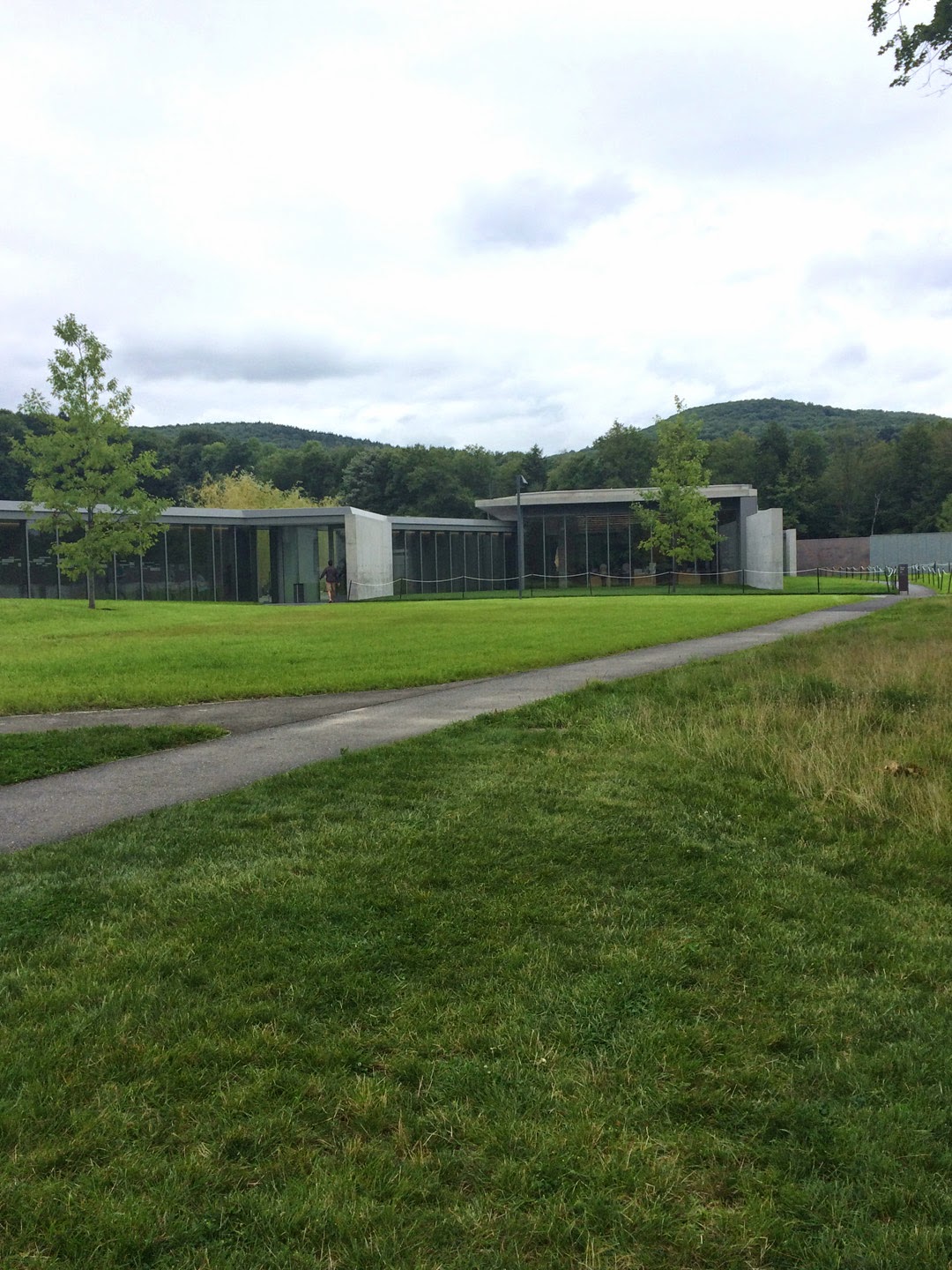
I thought the architecture was clean, crisp and a bit stark. The outdoor areas were lovely but the roped off grass everywhere really spoiled the look of inviting, lush greens contrasted with all the concrete and glass. Perhaps the ropes will be removed when the grass has had a chance to settle in, but somehow I doubt it.


Road Trip, Part 1: The Clark, Williamstown, Massachusetts

Bonnie and I used to take road trips all the time before we adopted our dogs and became more tied to home. We both love riding along and gawking at houses and either imaging how it would be to live there or being thankful that we don't. I've been wanting to see the architectural remaking of The Sterling and Francine Clark Art Institute (otherwise known as "The Clark") since reading about the transformation. So last Friday was the day.

On the Road

Berkshire Hill view, at least I think it's a Berkshire Hill. 

Williamstown, in the Berkshires of western Massachusetts, is a little more than 50 miles away from where we live in Easthampton and it's a scenic trip out there. Although the landscape is still very green and lush, it feels like fall is just around the corner and a few trees were already beginning to turn color.


Curving road on the beautiful grounds of the Clark

The museum addition (by Tadao Ando), gallery renovation (by Selldorf Architects) and landscaping (by Reed Hilderbrand) have been described much better by others, namely Roberta Smith in the New York Times, Sebastian Smee in the Boston Globe, and Lee Rosenbaum in the Wall Street Journal. Mostly, reviewers rave about the changes and improvements, but there's always one (or more) in the crowd who doesn't like change.


The original museum building, as iPhoned Friday.

I found the story of the original Clark, established by Robert Sterling Clark and his wife Francine, a fascinating one: Sterling Clark had piles of money inherited from the Singer Sewing Machine Company, became an adventurer and world traveler who shocked his conservative family by marrying a French actress. The couple's devotion to art collecting and  desire to preserve their collection for the future led to their building the Clark and opening it to the public in 1955. What's not to like?

So, just to let you know that this is just my relation of our road trip and my personal take on the Clark. If you want more, check the links.

The New Building and Layout


I'm showing you these three views because I'm not really sure which one leads to the correct entrance. We went in the wrong door, didn't see an admission desk and were inside for free and walking around the galleries in the original building. Apparently if you take a left instead of a right in the concourse between buildings, you are IN.


This is the concourse. To the left is the original building with American and European galleries.
To the right is the new building with special exhibitions. The plastic "bricks" on the wall honor donors.

The original cornerstone dedication.


The painting here was only postcard size but it contained incredible detail (Lucio Rossi, 1875).

Above are views of some of the European galleries in the original building. They have been revamped to have a cleaner and more spacious feeling. I did notice the difference from earlier visits. And the good thing about the redesign is that you can whiz right through these to get to what you really want to see.


Yes, it's all about the Ladies Room and this one was a real beauty - all that marble tile and beautiful soft light. It was just crying out for a selfie.

Apprehended and Shaken Down
Right after we emerged from the Ladies Room, we went up to a guard to ask where the Abstract Expressionist show was and of course he noticed that we weren't wearing the fluorescent orange wristbands that show you've coughed up your $20.


Passing quickly through the gift shop, we descended the stairs in the new building to pass through
the restaurant and find the Ab-Ex show.


Before descending, however, we took note of the wonderful views through the expansive glass walls.

Make It New: Abstract Painting From The National Gallery of Art, 1950-1975
Before showing you my amateur iPhone pictures, I recommend that for professional views you take a look at some links: the Clark's Facebook images of the show and also a review by Cate McQuaid in the Boston Globe with beautiful pictures.


Cy Twombly in the lobby area, Untitled (Bolsena) from 1969.

I don't want to be a tease, but this post is so long that I'm going to make a Part II with photos of some paintings and my observations. I like posting big images on this blog, but they do take up a lot of space and take some time to load. Plus I have to go watch the Netflix series that I'm bingeing on. First things first.